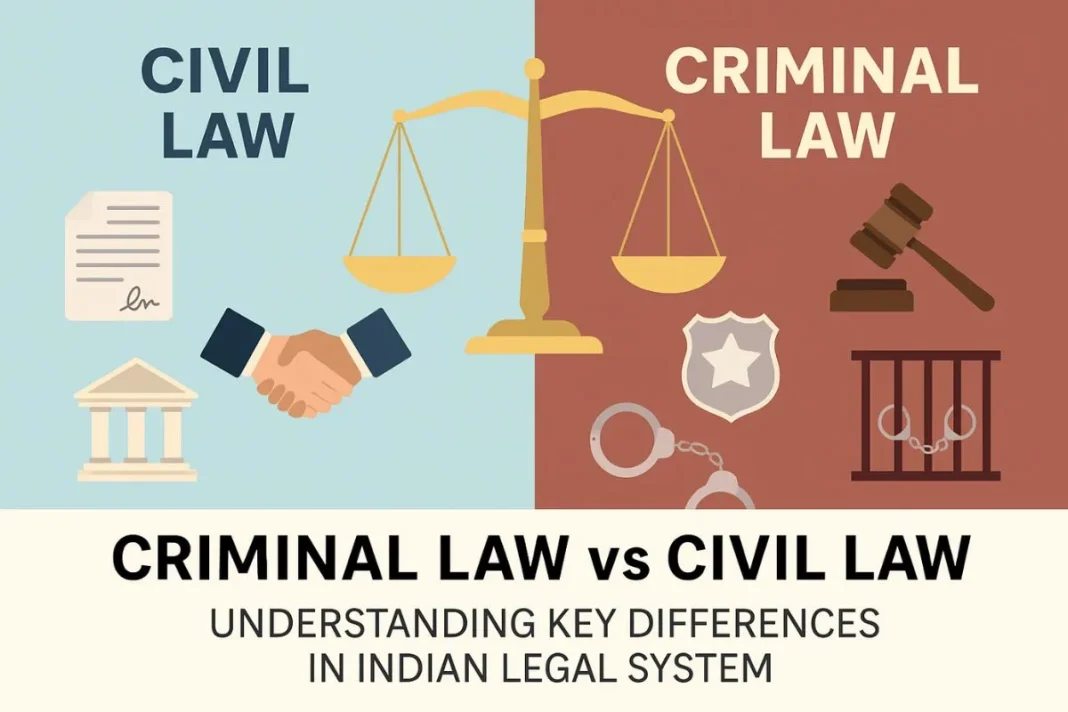

Most people have a vague sense that there’s a difference between criminal and civil cases, but couldn’t explain exactly what it is. This matters more than a legal trivia question. The difference determines who can sue you, what standard of evidence applies, whether you could go to jail, and how you should protect yourself. It also explains some seemingly paradoxical outcomes — like how O.J. Simpson was acquitted criminally but found liable civilly for the same events.
The Fundamental Difference: Who Is the Plaintiff?
In criminal law, the government prosecutes you. The case is titled ‘The People v. Smith’ or ‘The State v. Jones’ because the state — on behalf of society — is claiming that a law was violated. The victim is a witness, not the legal party bringing the case. In civil law, a private party sues another private party. The injured person directly brings a lawsuit seeking compensation. You can be involved in both simultaneously: the government can prosecute you criminally while the victim sues you civilly for the same underlying act.
The Standard of Evidence: Beyond Reasonable Doubt vs. Preponderance
This is where the O.J. Simpson outcome makes sense. Criminal cases require the prosecution to prove guilt ‘beyond a reasonable doubt’ — the highest standard in law, designed to protect people from wrongful imprisonment. Civil cases require only a ‘preponderance of the evidence’ — meaning more likely true than not, essentially anything over 50%. Someone can be acquitted of a crime (the state couldn’t meet the higher standard) but found liable in civil court (where the lower standard was met). Both outcomes can be legally correct at the same time.
Consequences: Liberty vs. Money
Criminal convictions can result in incarceration, probation, fines payable to the government, and a permanent criminal record. Civil judgments result in money damages paid to the winning party, injunctions (court orders to do or stop doing something), or other equitable relief. You cannot be jailed for losing a civil lawsuit in most circumstances (there are exceptions, like failure to pay child support or violating a court order). The stakes are different — which is why the standards are different.
Where Things Get Complicated
Some conduct generates both types of cases simultaneously. A drunk driver who injures someone faces potential criminal prosecution (DUI charges) and a civil personal injury lawsuit from the victim. A business that defrauds customers may face criminal fraud charges and civil class action litigation. Employment discrimination can trigger EEOC administrative proceedings, civil rights lawsuits, and in extreme cases, criminal civil rights violations. Understanding which type of case you’re dealing with — and what the rules are in that arena — is the first step in any legal situation.
Final Thoughts: The civil-criminal divide is foundational to how American law functions. Knowing which system you’re dealing with shapes everything — the timeline, the costs, the potential outcomes, and the strategies available. If you’re involved in any legal matter, whether as a potential defendant or as someone who has been wronged, clarifying which body of law applies is always step one.